Many people exploring energy healing ask the same question: what is the difference between Healing Touch and Reiki?
Both Healing Touch and Reiki are forms of energy healing therapy that work with the body’s energetic field to support relaxation, emotional balance, and overall wellbeing. While they share many similarities, the two modalities developed from different traditions and use slightly different approaches to working with energy.
At Brahmaloka Healing Arts, both modalities are honored for the unique ways they support healing. Understanding how Healing Touch and Reiki compare can help you decide which approach may feel most aligned with your personal wellness journey.
Below is a simple visual comparison explaining how Healing Touch and Reiki differ in their origins, techniques, and practice styles.
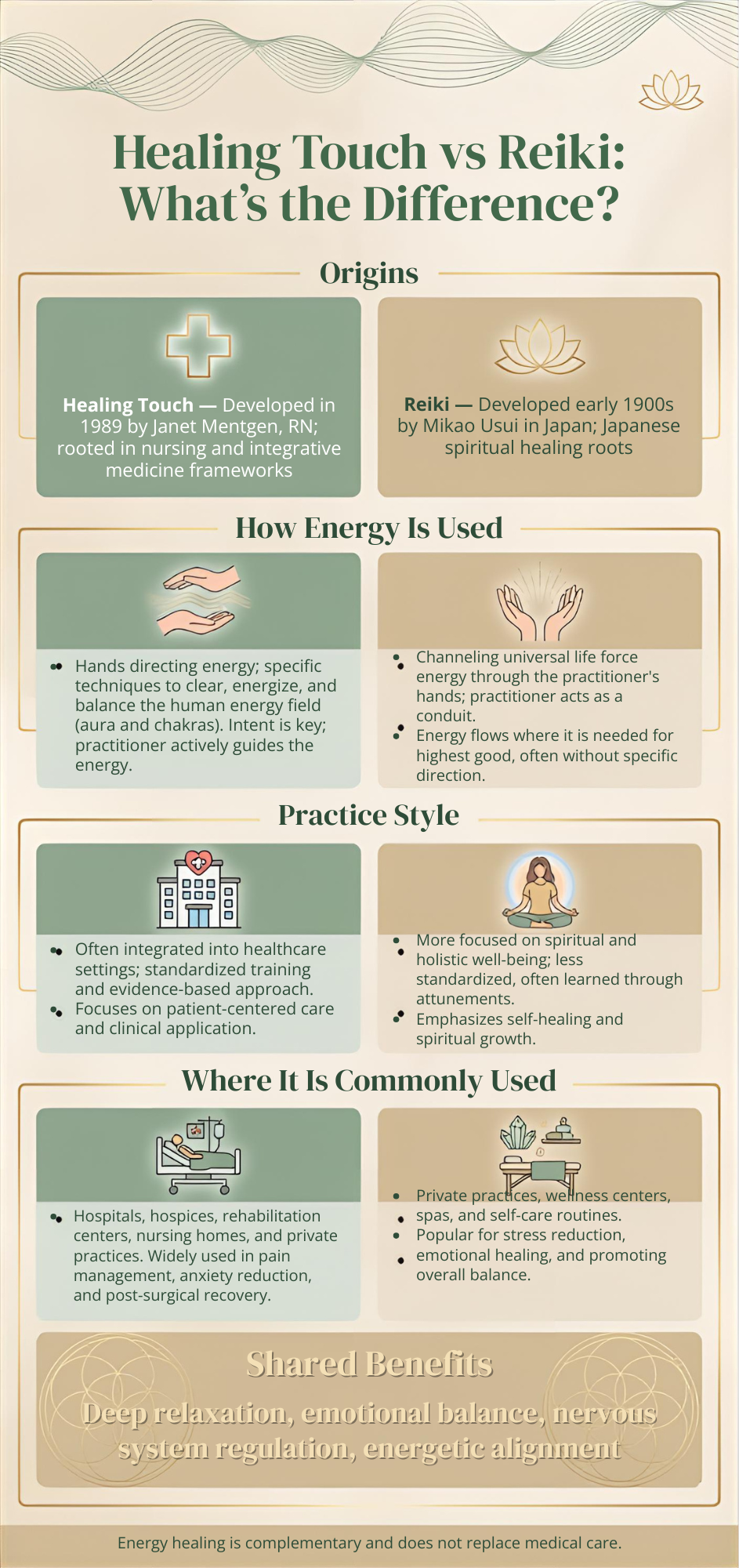
The main difference between Healing Touch and Reiki is how the practitioner works with energy.
Healing Touch practitioners actively assess and balance the body's biofield, using specific techniques to clear energetic congestion and restore energetic flow.
Reiki practitioners act as channels for universal life energy, allowing energy to flow naturally where it is needed rather than actively directing it.
Both modalities work with the body’s energetic system, but their techniques and traditions are distinct.
Healing Touch was developed in the late 20th century by Janet Mentgen, a nurse who believed that energy healing could complement traditional medical treatments.
In 1989, she founded Healing Touch as a structured and standardized energy healing modality designed to integrate with healthcare settings. Because of this clinical foundation, Healing Touch is now commonly practiced in hospitals, hospices, integrative medicine programs, and wellness centers.
Healing Touch blends modern energy medicine concepts with nursing principles, making it particularly accessible in clinical and integrative healthcare environments.
Reiki is an older practice with roots in Japan. It was developed in the early 1900s by Dr. Mikao Usui, who created a system for channeling universal life energy for healing purposes.
The word Reiki translates roughly to “Universal Life Energy.” Practitioners believe this energy can be channeled through the hands to support healing and balance within the body.
Reiki training follows a lineage-based system of attunements, where Reiki Masters initiate students into the practice and teach sacred symbols used to enhance healing energy.
Today Reiki is practiced globally in both holistic wellness environments and integrative healthcare settings.
Techniques and Approach: How Healing Touch and Reiki Work
Both Healing Touch and Reiki involve the practitioner channeling energy to facilitate healing. However, the techniques and approaches they use differ.
Healing Touch practitioners use a variety of hand movements and techniques to clear, balance, and energize the body’s energy field (biofield).
Common techniques include:
• magnetic clearing to remove blocked energy
• chakra connection to balance energy centers
• energetic assessment of the biofield
• customized hand placements near or on the body
Healing Touch sessions are often personalized based on the practitioner’s assessment of the client’s energy system and the client’s healing goals.
Healing Touch also emphasizes the role of intentional healing, meaning the practitioner consciously works with the client’s energy field to promote energetic balance.
Reiki sessions involve a standardized series of hand positions, typically placed lightly on or just above the body.
The practitioner channels Reiki energy through their hands, allowing the energy to flow where it is needed. Unlike Healing Touch, Reiki practitioners do not actively manipulate the energy field.
Instead, Reiki energy is believed to have its own innate intelligence, naturally moving to the areas of the body that need healing.
Reiki practitioners are trained through Reiki attunements, which connect them to the Reiki energy source and strengthen their ability to channel healing energy.
Although both Healing Touch and Reiki work with energy, their spiritual frameworks and underlying philosophies differ.
Healing Touch focuses on consciously directing energy to restore balance within the body.
While Healing Touch acknowledges a higher source of healing energy, it is not tied to any particular spiritual tradition. Because of this, the practice integrates easily with modern healthcare environments and diverse belief systems.
Healing Touch is typically viewed as a complementary therapy that works alongside conventional medical treatments.
Reiki is inherently spiritual, though it is not tied to a specific religion.
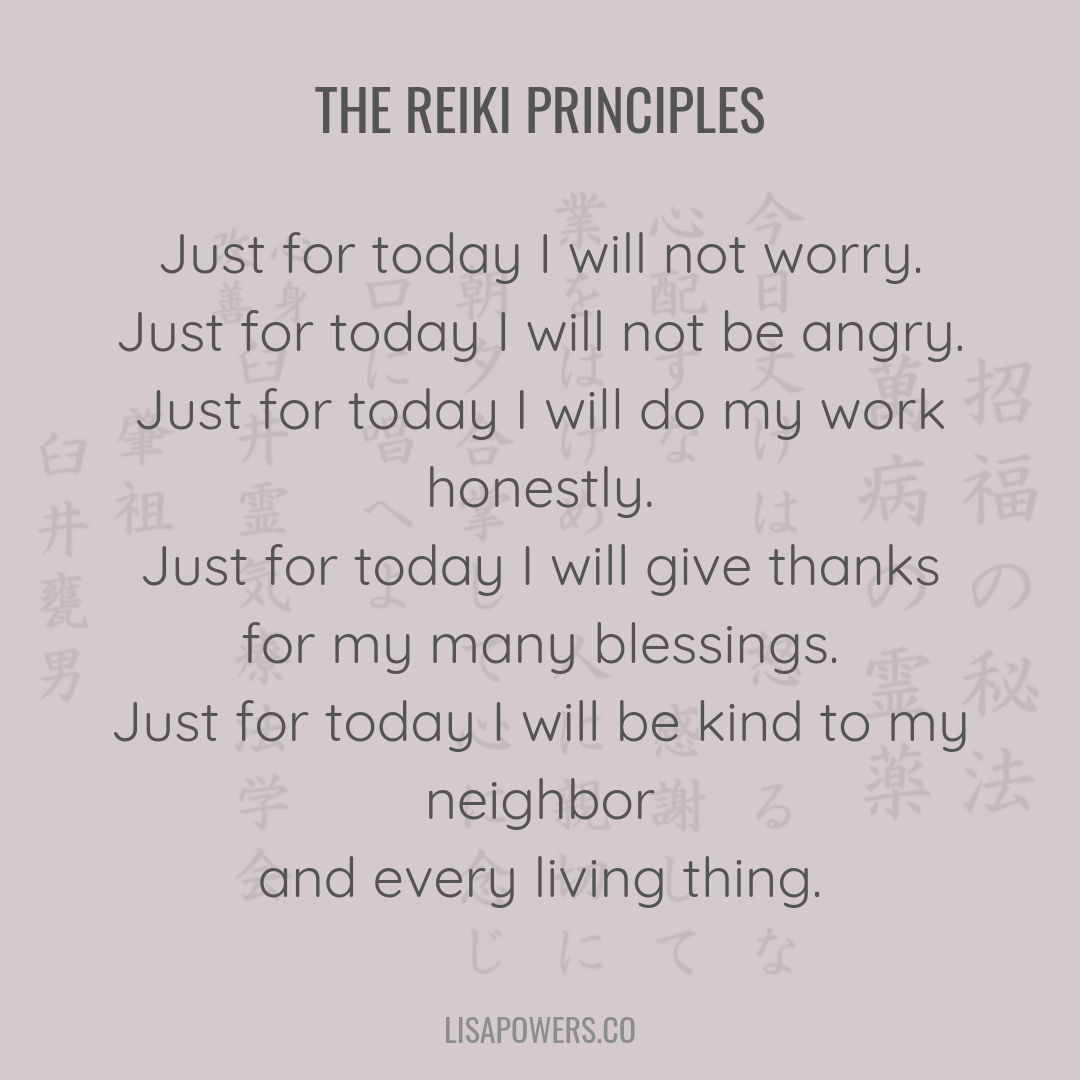
The practice emphasizes principles such as mindfulness, compassion, gratitude, and ethical living. Reiki practitioners often follow the Reiki Precepts, which encourage living with kindness, honesty, and emotional balance.
Because of its spiritual roots, Reiki is often experienced as both a healing modality and a personal spiritual practice.
Another notable difference between Healing Touch and Reiki is how practitioners assess energy and involve the client in the healing process.
Healing Touch: Healing Touch practitioners are trained to assess the client’s energy field before and after the session. This can involve using their hands to scan for imbalances or blocked energy, as well as listening to the client’s feedback about their emotional and physical state. The client is often actively involved in the session, with practitioners encouraging communication about their experience, intentions, and specific healing goals. Healing Touch is highly personalized, and sessions may vary greatly depending on the client’s needs.
Reiki: Reiki does not typically involve an energy assessment or scanning before the session. The practitioner trusts the Reiki energy to flow where it is needed, and the client is encouraged to simply relax and receive the energy without directing it. Reiki is often more meditative and quiet, with both the practitioner and client entering a state of peaceful receptivity. While clients can set intentions for healing, the process is more about surrendering to the universal energy and allowing it to do its work.
Both Healing Touch and Reiki offer powerful opportunities for healing, relaxation, and energetic balance.
Choosing between the two modalities often depends on personal preference.
Some people resonate with Healing Touch’s structured and clinically oriented approach, while others feel drawn to Reiki’s spiritual traditions and meditative nature.
At Brahmaloka Healing Arts, these modalities are offered as part of a holistic healing approach designed to support the whole person — physically, emotionally, mentally, and spiritually.
If you're curious about experiencing energy healing for yourself, sessions are available both in person and remotely.
Brahmaloka Healing Arts offers energy healing sessions designed to support relaxation, emotional balance, and energetic alignment.
Clients can experience healing in two ways:
• In-person Reiki energy healing sessions in Westminster, Colorado, where treatments take place in a peaceful and supportive studio environment.
• Distance Reiki healing sessions, allowing clients to receive energy healing remotely from anywhere.
Lauren Mangelinckx is a Registered Nurse, Certified Healing Touch Practitioner, Reiki Master, Clinical Herbalist, and holistic healer based in Westminster, Colorado.
As someone who has been highly sensitive to energy and empathic throughout her life, Lauren began exploring holistic healing more deeply in 2014 after experiencing her own health challenges and discovering the powerful role that energy work can play in restoring balance.
Her work integrates nursing principles, energy healing, herbal medicine, and holistic wellness practices to empower individuals to reconnect with their body’s natural ability to heal.
As part of her sessions, Lauren often provides comprehensive mind-body insights and personalized recommendations based on what arises during the healing process. Rather than offering a one-size-fits-all experience, her approach focuses on understanding the whole person — physically, emotionally, energetically, and spiritually.
Clients frequently receive thoughtful reflections and guidance following their sessions that help them better understand patterns within their health, stress levels, emotional wellbeing, and energetic balance. These insights allow clients to continue integrating the healing work long after the session itself.
This integrative and personalized approach makes each session a deeply supportive and premium healing experience, designed not only to provide relaxation in the moment but also to offer meaningful clarity and tools that support long-term wellbeing.
Healing Touch and Reiki are two well-known energy healing modalities that share a common goal: helping restore balance within the body’s energetic system.
While they come from different traditions and use slightly different techniques, both approaches offer a gentle and supportive way to encourage relaxation, emotional wellbeing, and energetic harmony.
For many people, the most important step is simply finding a healing approach that feels safe, supportive, and aligned with their personal healing journey.
With Gratitude and Love,
Lauren @ Brahmaloka Healing Arts
XOXO